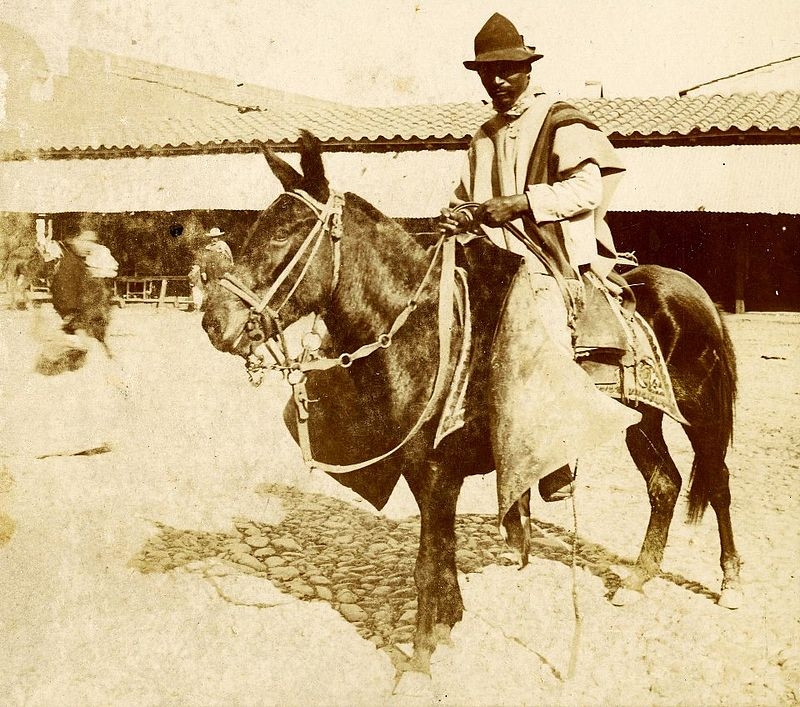
How to do lots of essential stuff in HI 216 onlinePhoto: Gaucho (cowboy) of Salta, Argentina, late 19th-century
This page gives you instructions on how to do many things in the course. Each of the main topics is vital to your performance in the course. Don't understand something? Ask!! You can't do what you don't understand.
[Navigation tip: If you right-click on any
of the menu items in the lefthand menu on the course home page, you can open that page in a new window which might be more convenient at times.]
- How to improve discussions & essays
- First, review your graded assignments and compare your answer with the rubric requirement. Honestly and thoughtfully examine what you did well, and what you failed to do.
- As you evaluate the discussions of your fellow students, consciously compare your own work. You can learn to improve from your colleagues.
- Read critically the model paragraphs posted by the instructor. Pay particular attention to instructor comments. Compare with your own work. You'll see ways to improve. Emulate those practices in your future discussions.
- To get individual help from the instructor, follow this procedure.
Do a self-assessment of one of your already graded assignments. Annotate a copy of the assignment, writing (in CAPS or another color font). Indicate what you perceive as its strengths and weaknesses paragraph by paragraph, comparing each with the rubric requirements. Email the annotated document to Prof. Slatta who will review your work and add his suggestions. Why this policy of self-assessment? YOU need to learn to think critically about your own academic work--it's called metacognition. Becoming more self-aware and self-critical will improve your performance in any course. [The diagram shows a suggested procedure for the assessment process.]

- How to synthesize/integrate information from different sources
The approach to this course requires that you synthesize or combine many different sources of information into a logical units (paragraphs). This is the key high-level cognitive skill that we work on repeatedly
(review Bloom's Taxonomy of Cognitive
Skills. To assist you in organizing and synthesizing, consult
and apply this Synthesis Matrix. Or you may use a concept map or outline to organize information from different sources into logical, topical paragraphs. When an assignment calls for using online primary sources or documents, use the Primary Sources link to locate them.
- How to communicate effectively
- All official email correspondence from the university must be sent to student Unity email addresses. Students have the option of forwarding their email to another account, but you must monitor Unity email either directly or via message forwarding.
- Write clear and professional email messages. Include a subject line, your full name, course and section numbers, and the specific assignment name and due date you're inquiring about. "Hey" is
never an appropriate salutation for anyone. Spell check and proofread the email. In an
online course, you ARE what you write.
- How to take a reading quiz
Your open-book reading quizzes are designed to measure whether you understand the course concepts in a specific chapter. Once you've read the relevant chapter, take the quiz. The quizzes are timed, but they are open-book. You may access to each quiz and each question only once, so allow sufficient time (60 minute time limit). Quizzes are available for one week before the due date/time.
- How to check your grades
Click on "Gradebook" in the Interactive History Lab to see your discussion, essay, and quiz grades. You are only responsible for the tasks listed on the assignments page. Ignore everything else, even if an entry exists in the gradebook.
|